Of all the gems I work with, abalone pearls draw the most questions, because most people have never seen one. They do not look like a classic round white pearl. They are wild, irregular, and lit from within with blues, greens, pinks, and silver. They are also genuinely rare. Here is what an abalone pearl actually is, why so few exist, and how to look after one if you are lucky enough to own a piece.
What is an abalone pearl?
An abalone pearl is a natural pearl that forms inside an abalone, a single-shelled sea snail (a mollusk) that lives on rocky coastlines. Like any pearl, it forms when the animal coats an irritant with layer after layer of nacre, the same material that lines the inside of the shell. Because the inside of an abalone shell is that famous swirl of color, the pearls take on the same shifting blues and greens. Most abalone pearls are not round. They form as horns, teardrops, baroque shapes, and flat “blisters”, and that wildness is exactly what collectors love.
Why are abalone pearls so rare?
Almost all abalone pearls are natural rather than cultured. Abalone are notoriously difficult to farm for pearls because they are sensitive animals that do not tolerate the bead-nucleation process used for other pearls well. So instead of a steady cultured supply, abalone pearls turn up mostly as a rare surprise when the animals are harvested for food. A diver might open thousands of shells without finding a single good pearl. That scarcity, plus the color, is why a fine abalone pearl is such a special thing to set.
What makes each one different
No two abalone pearls are alike. They vary in shape, in size, and most of all in color, which can run from deep peacock blue and green through to rose, violet, and silver, often several at once depending on the light. This is why almost everything I make with them is one of a kind. I let the pearl lead and build the setting around its shape rather than forcing it into a standard mount.
Love the look of abalone pearl? See the abalone pearl rings in my collection, each built around a unique natural pearl.
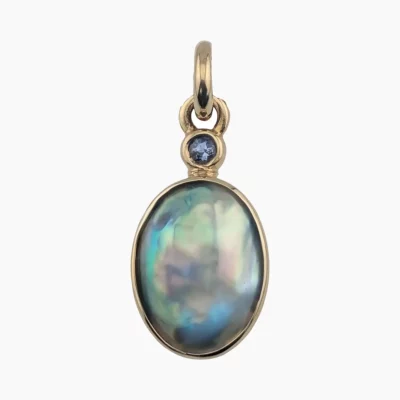
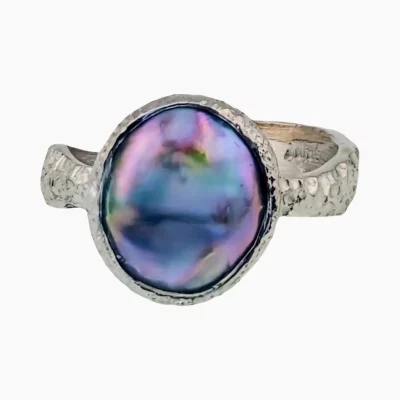
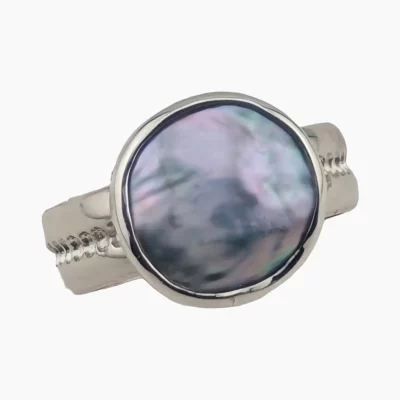
Three from my own collection show the range:
 A broad 15 by 17mm oval in blues and greens, set in 14K gold.
- A rare lavender pearl, 13 by 11mm, from Mendocino.
- A 12mm round from Shelter Cove in blues and silvers.
How to care for an abalone pearl
Abalone pearls are organic, like all pearls, so they are softer and more delicate than a stone like opal or sapphire. A few simple habits keep them beautiful:
- Put it on last. Perfume, hairspray, and lotion can dull the nacre over time. Dress, then add the jewelry.
- Wipe it after wearing with a soft, slightly damp cloth, then dry it. This removes skin oils and traces of anything it picked up during the day.
- No ultrasonic cleaners, steamers, or chemicals. Pearls hate all three.
- Store it soft and separate, in a pouch away from harder pieces that could scratch it.
- Keep it away from prolonged water. A splash is fine, but take it off for swimming and showering.
Wearing abalone pearls
Because the color does so much of the work, abalone pearls suit simple settings. I often use sterling silver or yellow gold and let the metal frame the color rather than compete with it. They make especially striking pendants and rings, where the pearl can catch the light as you move. Earrings are lovely too, though for a treasured pair I usually suggest keeping them for occasions rather than everyday wear, simply because pearls are soft.
Frequently asked questions
Are abalone pearls real pearls?
Yes. They are true natural pearls made of nacre, formed inside an abalone. They are not imitations. What sets them apart is their wild shapes and their blue-green color, which comes from the abalone shell itself.
Why are abalone pearls so expensive and rare?
Abalone are very hard to culture for pearls, so nearly all abalone pearls are natural and found by chance. Most divers open enormous numbers of shells for every good pearl, which keeps supply tiny and value high.
What colors do abalone pearls come in?
Mostly blues and greens, often with flashes of pink, violet, and silver. The exact mix shifts with the light, and no two pearls are the same.
How do I clean an abalone pearl?
Wipe it with a soft, slightly damp cloth and dry it gently. Never use ultrasonic cleaners, steamers, or chemicals, and keep it away from perfume and prolonged water.
Can an abalone pearl be set in a ring?
Yes, and they make beautiful rings. Because pearls are soft, an abalone pearl ring is best treated as a special-occasion piece and taken off for anything rough or wet.
Each abalone pearl I work with is unique, so the collection changes often. See what is available now, or talk to me about a custom piece built around a pearl you love.

Richard Lewis has worked at the jeweler’s bench for more than fifty years. He trained at the Revere Academy of Jewelry Arts in San Francisco and makes each piece in this shop by hand in his Santa Rosa, California studio. His specialty is natural opal and rare abalone pearls collected off the Mendocino coast over thirty years. More about Richard.