People often ask me whether Ethiopian or Australian opal is “better”. The honest answer is that they are both wonderful and they are not really competing. They come from different places, they formed in different ways, and they behave a little differently on the hand. Once you understand how, choosing between them gets easy. Here is how I explain it at the bench.
New to opals? Start with my guide to understanding opal.
The short answer
Australian opal is the long-established benchmark: stable, mostly non-porous, and prized for its body tone and pattern. Ethiopian opal is the newer arrival, often brighter and more affordable, but much of it is hydrophane, meaning it can absorb water and needs slightly more careful handling. If you want a stone you can be relaxed with, Australian leans that way. If you want maximum fire for the money and you do not mind taking it off before the shower, Ethiopian is hard to beat.
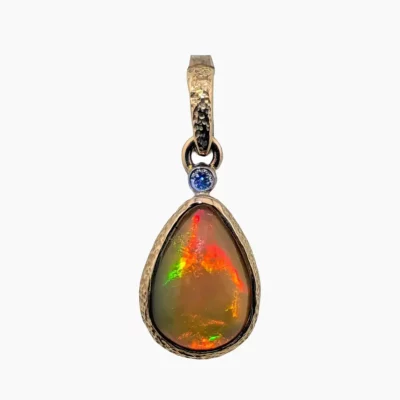
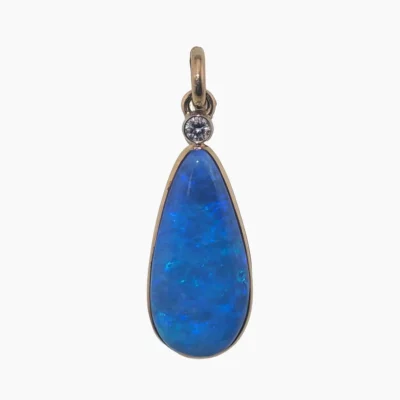
Here are the two side by side, both from my own bench:
 Ethiopian: a 1.96 carat Ethiopian pear with the warm, lively fire the material is known for.
- Australian: a 6.05 carat Coober Pedy pear in deep, rolling blues.
Where they come from
Australian opal has been mined for well over a century, from fields like Lightning Ridge, Coober Pedy, and Andamooka. It built opal’s reputation as a precious gem. Ethiopian opal, particularly from the Wollo (Welo) province, only came to the market in real quantity from around 2008. In a short time it has become one of the most exciting opal sources in the world.
How they formed, and why it matters
Most Australian opal is sedimentary and formed slowly in ancient rock. Much of the Wollo Ethiopian opal is volcanic in origin and is hydrophane, which simply means “water loving”. A hydrophane opal is porous enough to take in water, which is why it can temporarily turn cloudy if it gets soaked and then clear again as it dries. Australian opal is generally not porous in this way, so it shrugs off contact with water more easily.
Fire and color
This is where Ethiopian opal wins a lot of hearts. It often shows broad, vivid flashes of color across a bright or crystal-clear body, and good examples can be spectacular. Australian opal tends to be valued for a deeper body tone (black opal being the most prized) and for the rarity of certain patterns. Neither is “more colorful” as a rule. Both can be gorgeous, but the look is different: Ethiopian often reads as bright and lively, Australian as deeper and more saturated.
Drawn to one of these opals? Browse the opal rings in my collection, set with both Ethiopian and Australian stones.
Hardness and durability
Both sit around 5.5 to 6.5 on the Mohs scale, so both are softer than quartz and need protecting from knocks and scratches. The practical difference is water sensitivity, not hardness. Australian opal is more forgiving day to day. Ethiopian opal asks you to keep it away from prolonged water, oils, and chemicals so it stays at its best.
Price
As a general rule you get more visible fire per dollar from Ethiopian opal. Fine Australian opal, especially black opal, reaches the highest prices in the opal world. That is part of why I work with a lot of Ethiopian material: it lets me set genuinely vivid stones in solid gold at prices that stay sensible.
So which should you choose?
- Choose Australian opal if you want the most carefree wear, a deeper traditional body tone, or you are drawn to black opal specifically.
- Choose Ethiopian opal if you want the brightest fire for your budget and you are happy to take a little care around water.
- For a daily ring, either works, but handle the stone gently and take it off for rough work whichever you pick.
- For a pendant or earrings, water sensitivity barely matters, so let color be your only guide.
Frequently asked questions
Is Ethiopian opal real opal?
Yes. Ethiopian opal is genuine precious opal with the same play-of-color as Australian opal. The main difference is that much of it is hydrophane (porous), so it can absorb water temporarily.
Is Australian opal more valuable than Ethiopian opal?
At the very top of the market, yes. Fine Australian black opal commands the highest prices. For most pieces, though, Ethiopian opal offers more fire for the money, which is why it is so popular.
Why does Ethiopian opal change color in water?
Because much of it is hydrophane and absorbs water into its porous structure, which makes it look cloudy until it dries out fully. This is normal and almost always reverses over a day or two. Australian opal does not usually do this.
Which opal is easier to look after?
Australian opal, slightly, because it is generally not porous. Ethiopian opal is just as wearable as long as you keep it away from prolonged water, oils, and harsh chemicals.
Can you set Ethiopian opal in a ring?
Absolutely. I set Ethiopian opal in rings, pendants, and earrings. For rings I simply remind customers to take the piece off before anything wet or rough.
Want help choosing a stone, or have one in mind for a custom piece? Contact me or see what is in stock. For looking after your opal once it is home, read how to care for opal jewelry, or learn more about Australian opal.

Richard Lewis has worked at the jeweler’s bench for more than fifty years. He trained at the Revere Academy of Jewelry Arts in San Francisco and makes each piece in this shop by hand in his Santa Rosa, California studio. His specialty is natural opal and rare abalone pearls collected off the Mendocino coast over thirty years. More about Richard.