“What does an opal actually look like?” is one of the first things people ask me, and it is harder to answer than it should be, because no two opals look the same. A photograph never quite captures it either, since the whole point of the stone is that the color moves. Still, there are patterns to learn, and once you know what to look for you will read an opal much more confidently. Here is a visual guide to body tone, pattern and opal colors, the three things that decide how an opal looks.
Body tone: the background of the stone
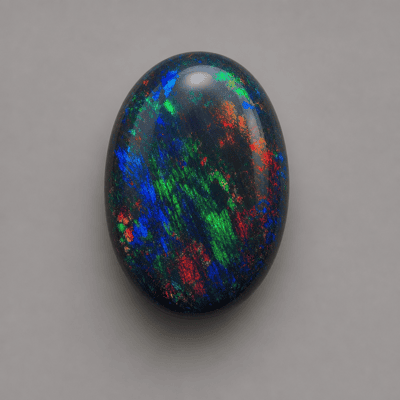
Start with the body tone, the background the color plays against. It runs from black through gray to milky white and on to water-clear. The darker that background, the more the colors leap out. The same flash of green looks electric against a black body and gentle against a white one. This is why a dark stone reads as dramatic and a pale stone as soft, before you even consider the color itself.
Play-of-color: the patterns
The shifting flash is called play-of-color, and it arranges itself into recognizable patterns. A few worth knowing:
- Pinfire is a scatter of tiny, close-set points of color, like sparks.
- Broad flash shows larger sheets of a single color that light up and fade as you tilt the stone.
- Rolling flash is a band of color that seems to roll across the surface as it moves.
- Harlequin is the rare and prized one, a mosaic of broad, roughly equal patches like stained glass.
Color: what is common and what is not
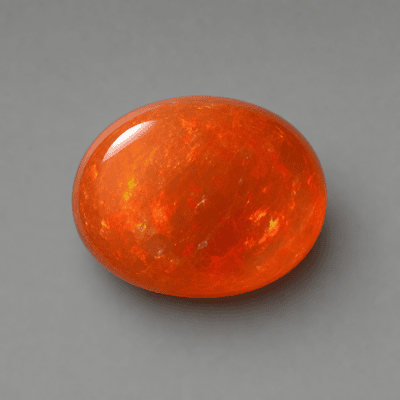
Most opal shows blue and green, because those colors come from the smaller, more common silica spheres. Orange and red are far rarer and need larger, more even spheres, which is why a red stone usually costs the most. So a quick way to gauge a stone is to ask how much of the rarer color it shows, and how brightly.
Want to see it move for yourself? Browse the handcrafted opal rings in my collection, each photographed and set with a stone I chose by hand.
What the main types look like
Pull the patterns and body tones together and you get the familiar types, each with its own look.
 Black opal looks deep and dramatic, its colors glowing against a dark body.
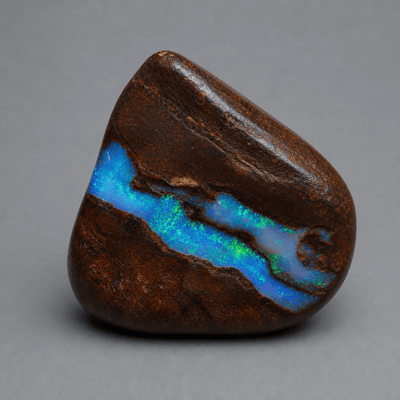
- Boulder opal shows bright color set against, and often weaving through, brown ironstone.
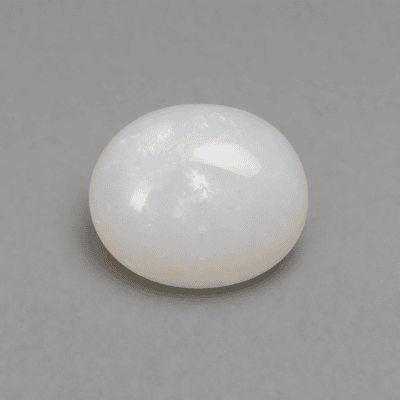
- Crystal and white opal look light and airy, the color floating in a clear stone or softened in a milky one.
- Fire opal glows a warm orange or red, sometimes with play-of-color over the top.
For the full roster and how the names overlap, see my guide to the types of opal.
Frequently asked questions
What color is opal? The body can be black, gray, white or clear, and the flashing play-of-color can show any spectral color. Blue and green are most common, red the rarest.
Does real opal change color when you move it? Yes. Genuine precious opal flashes and shifts color as you tilt it, which is the play-of-color. A stone that looks the same from every angle is either common opal or an imitation.
Why do opals look different in photos? Because the color depends on the angle of the light and the stone, a single photo only catches one moment. This is why I always recommend seeing an opal in person or in several views before buying.
To understand what you are looking at in full, from what opal is to what it costs, read my guide to understanding opal. Or browse the current opal rings and see the stones for yourself.

Richard Lewis has worked at the jeweler’s bench for more than fifty years. He trained at the Revere Academy of Jewelry Arts in San Francisco and makes each piece in this shop by hand in his Santa Rosa, California studio. His specialty is natural opal and rare abalone pearls collected off the Mendocino coast over thirty years. More about Richard.