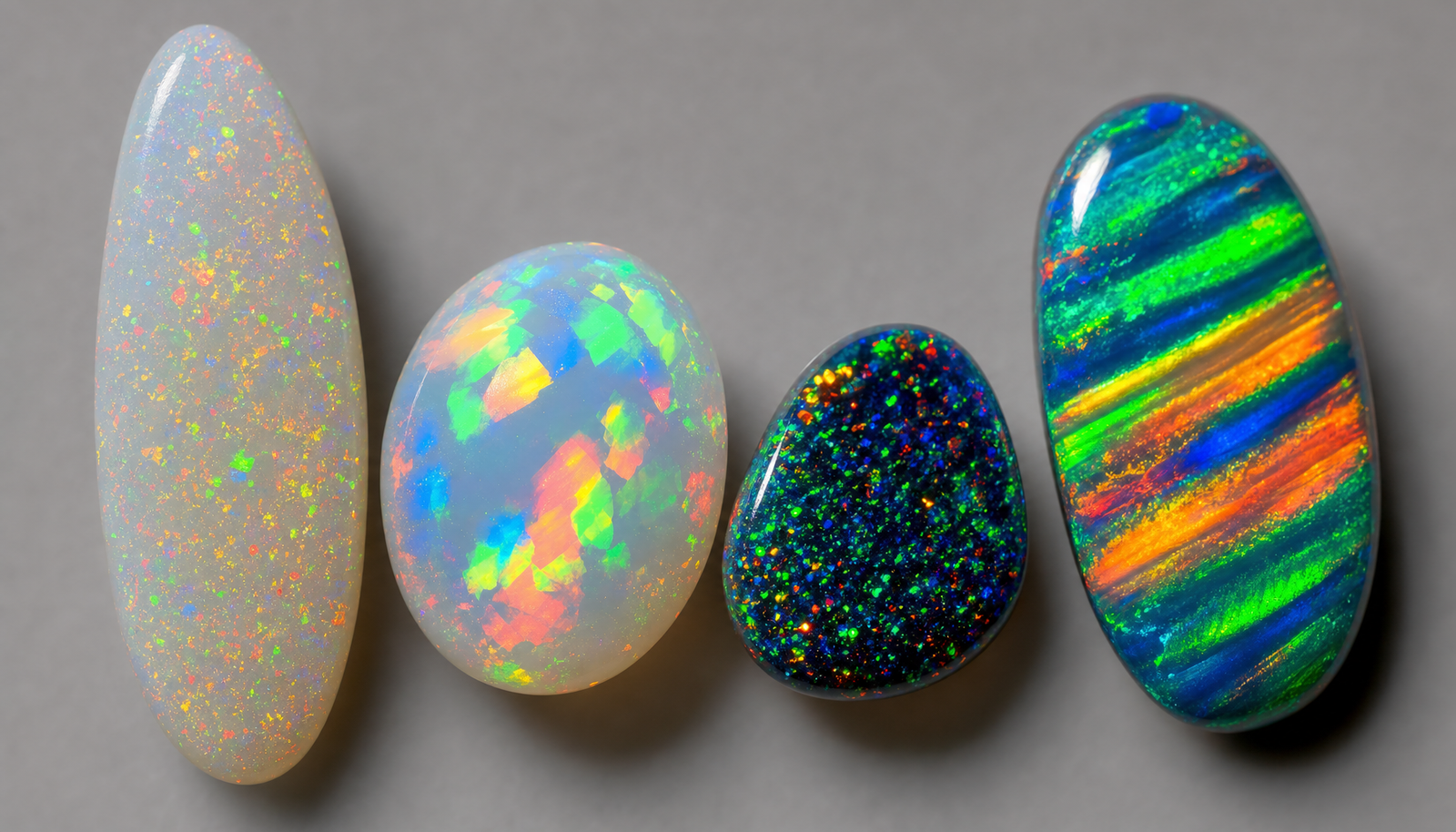
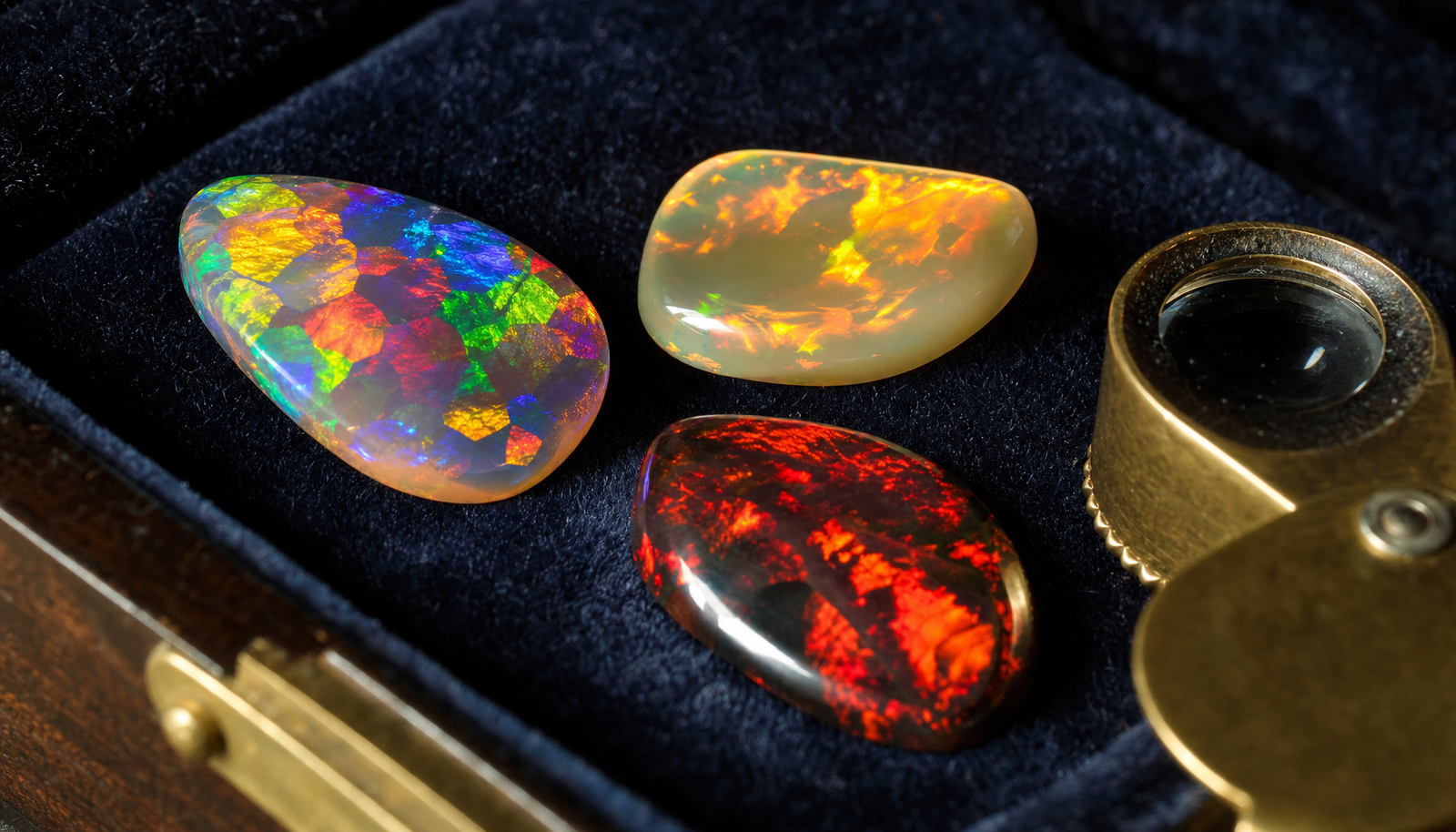
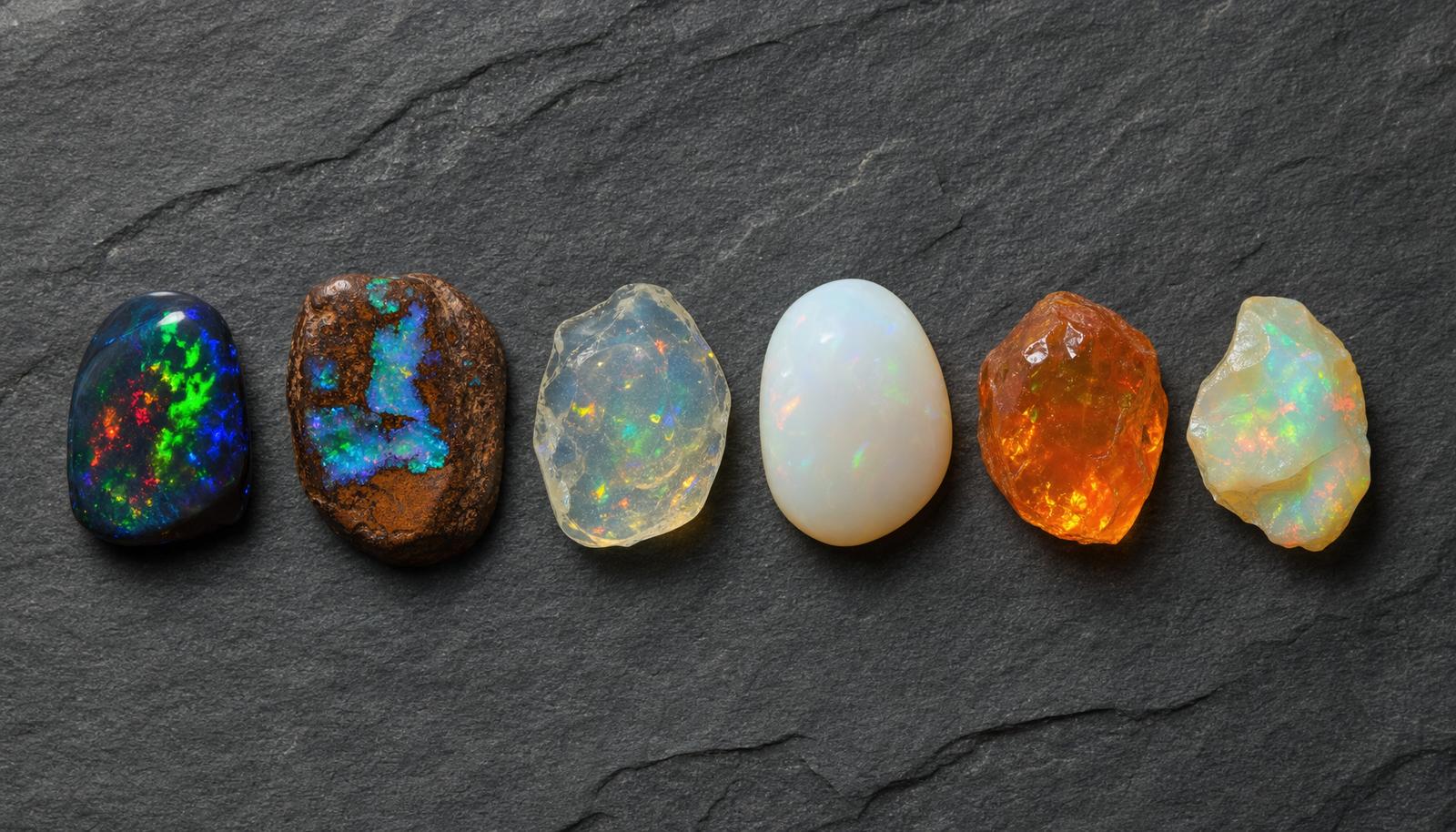
When I buy opal rough straight from the miners, no middleman in between, the parcel that lands on my sorting tray never looks like a single “gemstone.” In the same handful I might find a flash of precious color, a chunk of dead gray potch, a slab still fused to its ironstone, and a rock threaded with color instead of holding a solid seam. Any customer who asks me to define opal in plain terms is really asking me to sort that tray for them, because “opal” covers all of it, and knowing which form you’re holding changes what it’s worth and how you should treat it.
This page pins the word down properly: the technical definition, where the term came from, and what should not be sold under it. If you want the friendlier walk through the stone itself, my guide to what opal is covers that side.
Opal, defined: a natural mineraloid of hydrated amorphous silica (SiO2·nH2O), silicon dioxide with water bound inside it and no ordered crystal structure. Opal that shows play-of-color is precious opal; opal that does not is common opal.
The definition, unpacked
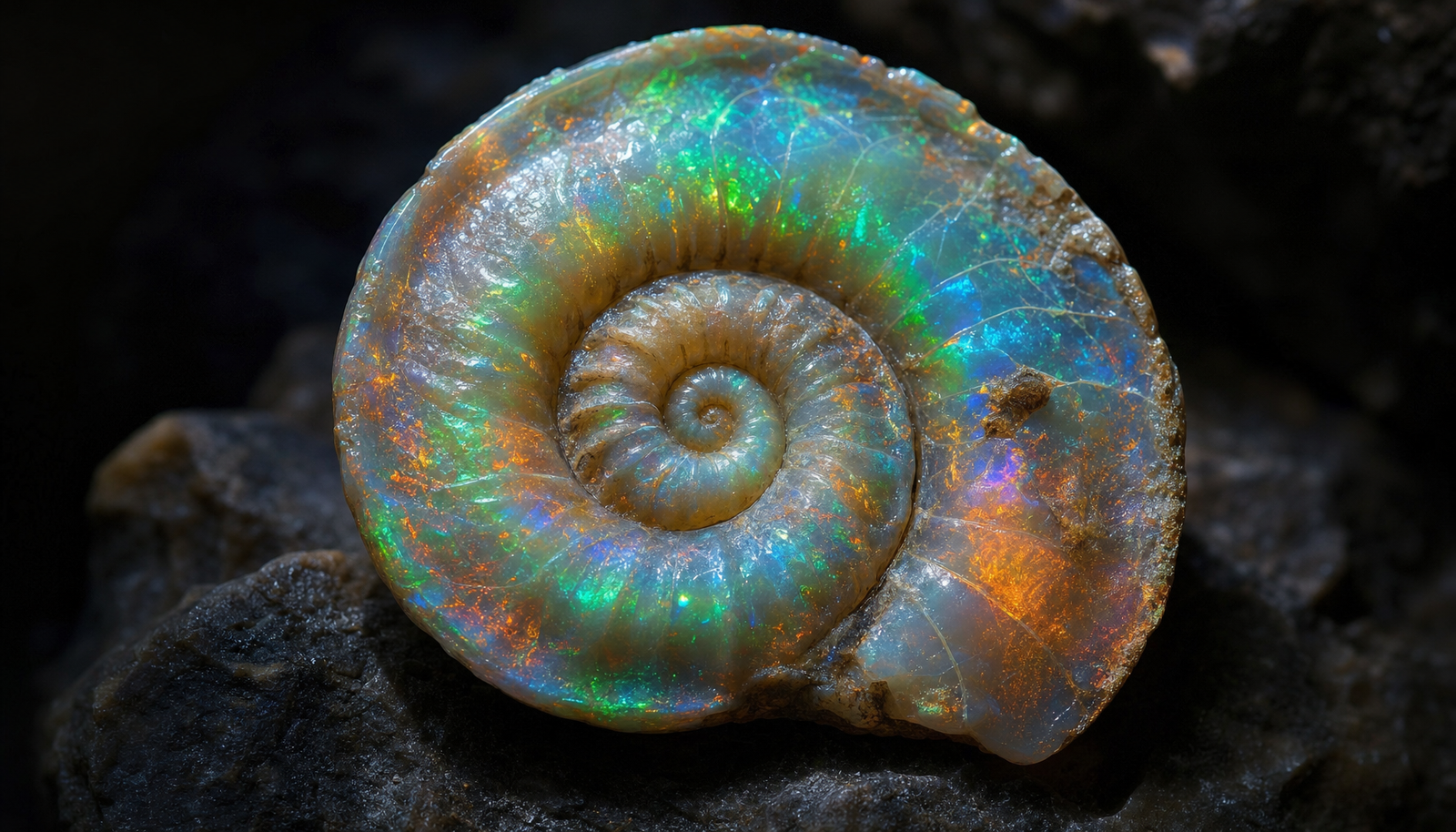
Opal is a mineraloid, not a true mineral. It is silicon dioxide with water trapped inside its structure, and unlike quartz, amethyst, or topaz it has no regular crystal lattice. It is amorphous, which is the technical way of saying its silica spheres are packed together without the repeating internal order a true crystal has. That single fact, no crystal structure, is why gemologists file opal under mineraloids alongside amber and obsidian. The GIA’s opal reference puts the water content anywhere from 3 to 21 percent by weight, usually 6 to 10 in gem material, and that matches what I handle. The water is really in there, too: mineralogists confirm it in rough samples by driving it off with heat and weighing the loss, which makes this a testable definition rather than a poetic one. That same hydrated silica is also what fills in shells and bone underground, which is how you end up with an opalized fossil instead of a seam in ironstone.
Where the word comes from
The word has been traveling a long time. Most references trace opal through the Latin opalus and the Greek opallios, a word tied to seeing a change of color, back to the Sanskrit upala, which meant nothing fancier than precious stone. I like that the oldest root is the plainest one. English writers were using opal by the late 1500s, and opalescent came later for the milky shimmer of common opal. That shimmer is also why frosted white glass gets sold as opal glass, a borrowed name with no opal in it.
Want to see the definition in stone form? Browse the handcrafted opal rings and opal pendants in my collection, or ask me about a custom piece.
What the word covers in the trade
Split the definition in two and you have most of the trade vocabulary. Common opal, potch to a miner, is the same silica with no play-of-color: milky, solid-colored, mostly background material. Precious opal flashes shifting color as it moves under light, and when someone in the trade says opal without qualifying it, that is the stone they mean. The flash comes from silica spheres stacked in rows so orderly they split light like a prism, which I cover properly in how opal color actually works, and the full family tree is in my guide to understanding opal. One wrinkle worth knowing: fire opal is named for its warm body color, not for flash, so a stone can be true fire opal with no play-of-color at all.
What counts as opal, and what does not
Because the word sells, it gets borrowed. Here is the boundary line as I hold it when I buy:
- Opalite is man-made glass with a milky glow. Pretty and cheap, and not opal at all. The name alone should not cost anyone real-opal money.
- Lab-created opal is real silica built into the same ordered structure, so it shows genuine play-of-color. Opal in structure, human in origin; an honest seller labels it created or synthetic.
- Dyed and resin-treated matrix starts as genuine opal-bearing rock and gets helped along. Still opal, but the treatment must be disclosed and it changes how you care for the stone.
- Opalized shell and bone are the real thing. Silica replaced the original material underground, so the fossil is opal through and through.
- Doublets and triplets hold a genuine slice of opal in a layered sandwich. Real opal in part, an assembled stone as a whole. Both are in the sorting-table list below.
The six forms on my sorting table
A short glossary helps here, since the trade uses a handful of terms loosely and it pays to know what you’re actually looking at. These are the six forms I sort out of a rough parcel most often, and I’ve put a photo next to each so you can tell them apart on sight, the same way I have to at the sorting table.
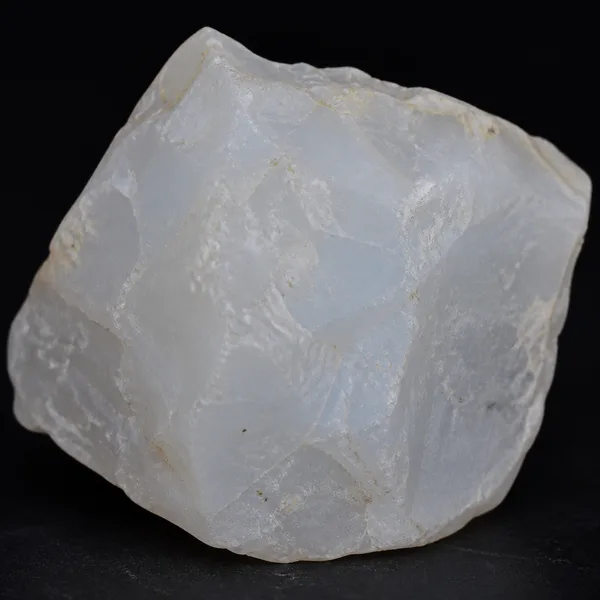
 Potch: common opal with no play-of-color, often found surrounding or near precious seams. I see far more of this in any rough parcel than the good stuff, and it’s usually the first thing I set aside when I’m sorting.
-
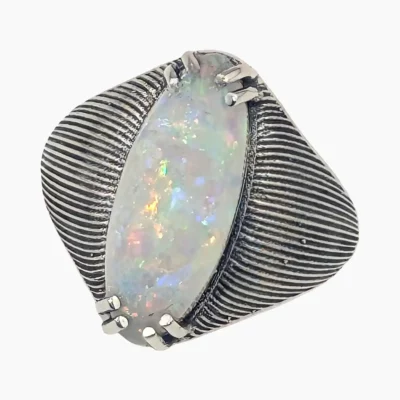
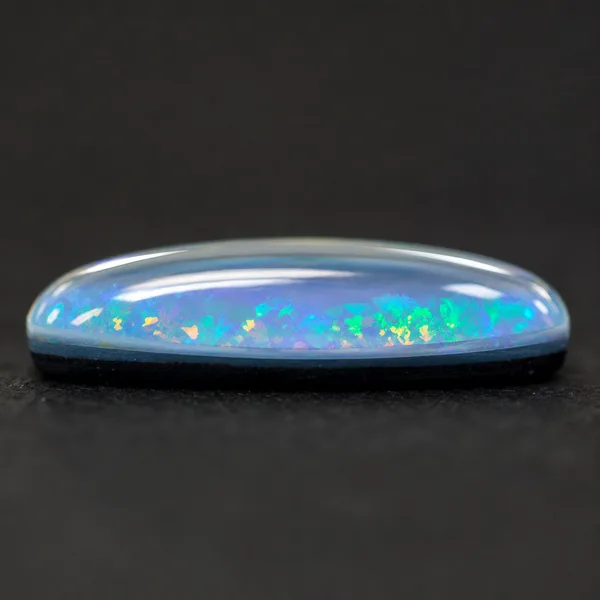
Body opal: a solid piece of precious opal cut and polished on its own, without a backing. This is what I’m hoping to find when a seam in the rough shows real color all the way through. The 2.67 carat Coober Pedy solid in this ring is exactly that, one piece of precious opal, cut and polished with nothing behind it.
-
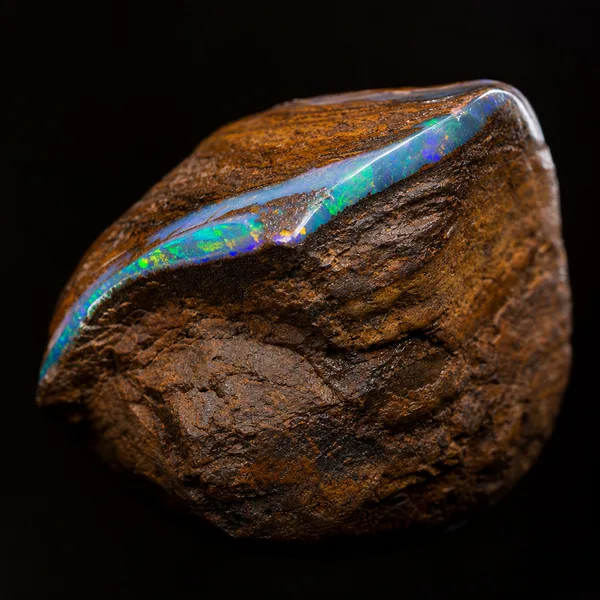
Boulder opal: precious opal left attached to its natural ironstone host rock rather than cut free of it. When the color seam is thin, I’d rather leave the ironstone under it for strength than fight to free a sliver that would crack.
-
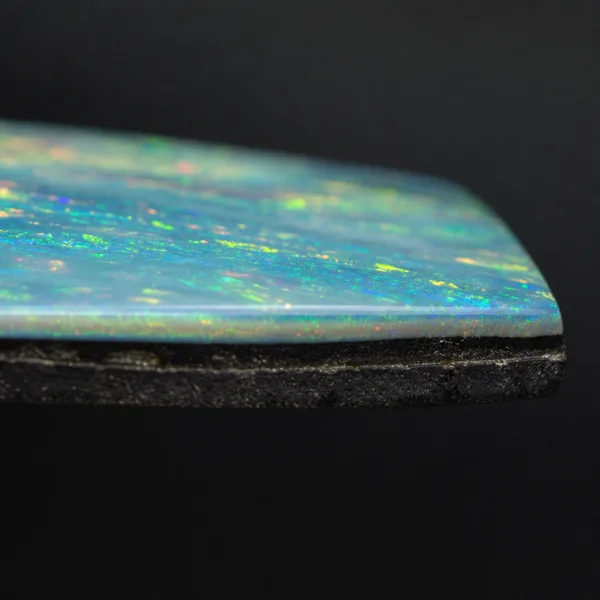
Doublet: a thin slice of precious opal glued to a backing, usually black potch or glass, to deepen the color. It’s a manufacturing process, not something a miner digs, so it never turns up in a parcel of rough. I don’t build these; I cut solid stone from the material I buy.
-
Triplet: a doublet with a clear cap, usually quartz or glass, added on top for protection. The cap is the giveaway under magnification, a sharp line where the dome meets the opal underneath.
-
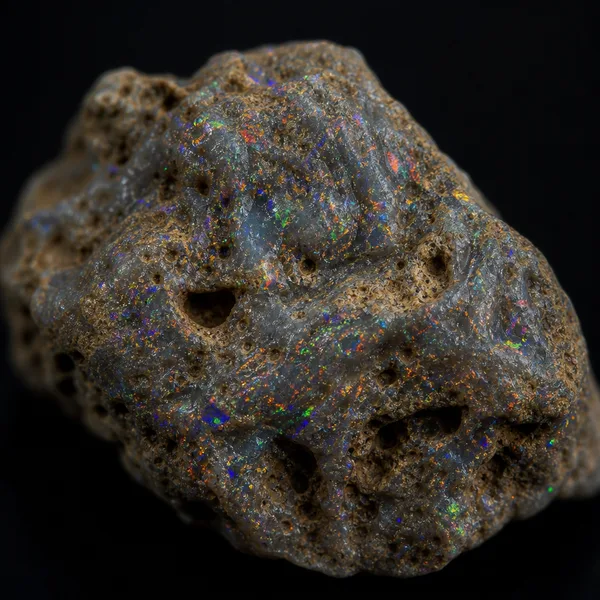
Matrix opal: precious opal distributed through a porous host rock rather than forming a solid seam. Some matrix on the market has been dyed or resin-treated to deepen that scattered color, so I always check a piece closely before I’ll buy it.
Each of those terms answers a slightly different version of “what is this opal,” which is part of why a plain definition of the stone only gets you so far without them.
A definition tells you what a stone is, not how it got there or why anyone wants one. Those are separate stories: how opals are made covers the geology, and my guide to the meaning of opal covers everything the chemistry leaves out.
Frequently asked questions
Is opalite real opal? No. Opalite is man-made glass with an opal-like glow and no silica-sphere structure. Lab-created opal is a different case: genuine silica with genuine play-of-color, grown by people and sold honestly as created opal.
Is opal a mineral or a gemstone? It’s a gemstone but not a true mineral in the strict sense, since it lacks a defined crystal lattice. Gemologists classify it as a mineraloid.
Does the definition of opal include color? No. The mineral definition covers composition and structure only. Play-of-color is a separate property that only some opal has, which is the line between precious and common opal.
Why does opal contain water? The water was trapped in the silica gel as opal formed underground. It’s part of the stone’s composition, which is why very dry conditions can occasionally cause lower-quality opal to crack over time.
Once you have the definition down, the more interesting question is what makes one opal worth setting in gold and another worth passing over. That’s a judgment I make by eye, stone by stone, after fifty years at the bench. Browse the current opal rings in my shop, or get in touch if you’d like something made to order.

Richard Lewis has worked at the jeweler’s bench for more than fifty years. He trained at the Revere Academy of Jewelry Arts in San Francisco and makes each piece in this shop by hand in his Santa Rosa, California studio. His specialty is natural opal and rare abalone pearls collected off the Mendocino coast over thirty years. More about Richard.